Playtime Magazine Edition Header
Home » April 2010, Cinema and Television, Subheadline

Kick-Ass shoots itself in the foot

22 April 2010 1,558 Views 7 Comments author: Isabelle M.

kick-ass1If you have had regular access to the internet these past six months, you have no doubt been exposed to the extensive marketing campaign that preceded the release of KICK-ASS. Not a week went by without new trailers, vignettes, movie stills or one of the approximately 150 posters, making this easily the most-hyped release of the first half of 2010. Kick-Ass is based on the comic-book by Mark Millar (Wanted) and John Romita Jr. and adapted for the screen by director/writer Matthew Vaughn (Stardust, Layer Cake) and Jane Goldman. Now that it’s finally arrived, critics can be roughly divided into two types:
–Those that applaud Kick-Ass for being a clever satire/smart deconstruction/subversion of the superhero genre, and
–Those that condemn it for being morally bankrupt for its sadistic violence and foul language.

For reasons explained before, I don’t believe the hype, either positive or negative. And after witnessing Kick-Ass with my own two eyes, I am forced to admit that both groups of critics are wrong.

Dave Lizewski (Aaron Johnson) is a typically average teenage boy, whose only superpower is to be invisible to girls. As he himself admits, he’s not even the funniest among his friends. This is true, since he has only two friends cast for comic relief. It is safe to say that Dave is the least funny of his friends.

One day while drinking coffee at the comic book-store, Dave wonders why normal people don’t dress up as superheroes to fight crime. One of his friends sensibly replies: “Because they’d get their ass kicked”. Unfortunately, this fundamental truth fails to penetrate Dave’s head and one casual mugging on the way home later, Dave decides to reinvent himself as a superhero. With the help of a scuba-suit and a ski-mask ordered off the internet, Kick-Ass is born. And is promptly stabbed  and run over by a car for his troubles.

Now if the movie had ended there, it would have been a perfect lesson about the follies of wish-fulfillment. Short, succinct and to the point. Unfortunately we’re only 20 minutes in and there is a lot more to come.

The trip to the hospital has left Dave with metal plates grafted to his bones—just like Wolverine. And yes, that line of dialogue is actually used in case we couldn’t figure that out for ourselves. Thank you, Dave—and deadened nerve ends that make him impervious to pain. He leaves the hospital with a reputation as a gay-prostitute, which finally brings him to the attention of the girl of his dreams Katie Deauxma (Lyndsey Fonseca) but not in the way he hoped. He still wants to bone her, she looks at him as a potential gay best friend. Yes, this is an actual part of the plot. I swear I am not making this up.

You’d think that after nearly getting killed, Dave would think twice about going out as Kick-Ass again, but before you can shout “You dumb fuck!” he’s at it again.

This time, he comes across three gangbangers beating up on a helpless guy, and Dave wouldn’t be Dave if he didn’t jump to the defense of the victim. This part, I actually liked.

This fight, and the one before, are shot as frantic affairs of street-brawling. None of the parties seem to have anything but the most basic grasp of fighting, which is to inflict as much pain as possible to the other guy. It’s vicious, frenetic, brutal and the camera-style fits it perfectly. It’s also a scathing commentary on the apathy of the general public. When Kick-Ass calls out to a bystander to call 911, he instead gathers a crowd that become silent spectators, while filming the fight on his cell-phone. It’s reminiscent of the news-stories you hear about a person drowning while a crowd of spectators watched and did nothing. This scene also marks the only time I felt sympathy for Kick-Ass . As he stands over the prone victim, obviously spent and still refusing to give up, I must admit his weary defiance warmed my heart—briefly.
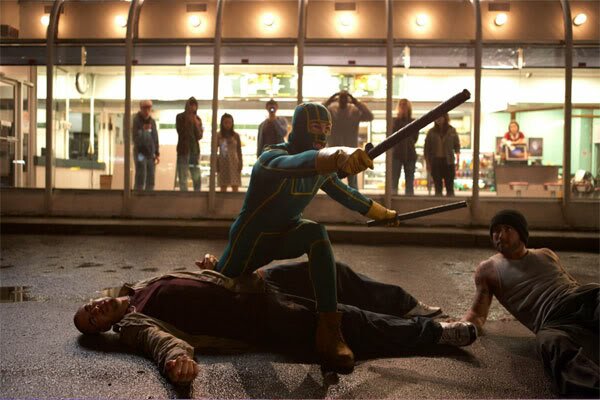
kick-ass-movie-2

YOU SHALL NOT PASS!

Unfortunately, this warm feeling doesn’t last long. The video of Kick-Ass gets uploaded to youtube and seemingly overnight, he becomes a viral success. I’m sure this was meant as a comment on internet popularity. Dave comments that he, as Dave, has only 36 friends on Facebook, yet Kick-Ass has 16,000 and counting. Dave does strike me as the type of person who puts a great deal of stock in the number of virtual friends he accumulates. There’s also some more pussy-footing at this point involving the developing relationship between Katie and her new-found gay best friend that I sort of tuned out.

By the way, I should interject at this point that it’s not the acting that’s at fault. Both Johnson (who is English, and colour me surprised when I found out) and Fonseca do the best with what they’re given. It’s just that both characters are so bland, that I couldn’t care less about their relationship. In fact, every time the movie went in that direction, I wished for something to take the focus away from it.

And boy, was I in luck.

For meanwhile, across town, disgraced ex-cop Damon MacReady and his 11-year old daughter Mindy (Nicolas Cage and Chloe Moretz) are playing the vigilante game as well, albeit with much higher stakes. Not content with battling petty crime like Kick-Ass, they have set their sights on local crime-boss Frank D’Amico (Mark Strong), the man they hold responsible for the death of Mrs. MacReady. And as masked crime-fighters Big Daddy and Hit-Girl, they’re really doing a number on Frank’s organization. Unfortunately for our hapless hero Kick-Ass, this coincides with his newly minted popularity, forcing Frank to conclude that Kick-Ass is the vigilante behind the systematic destruction of his underlings. As a result, he puts a price on Kick-Ass’ head.

the-macreadys

Tool up, honey-bunny.

You just know that sooner or later, Dave and the Macreadys’ paths are going to converge. They do, and oh in what glorious fashion!

Dave, still playing the gay chump to Katie, decides to do her a favour by having Kick-Ass deliver a stern warning to her drugs-dealing ex-boyfriend Rasul. Needless to say he’s in way over his head. Lucky for him, Rasul’s crew just so happens to be part of Frank’s crew. And Big Daddy and Hit-girl just so happen to be targeting Rasul on the same night as Kick-ass.

And this is the point where the whole film turns to shit.

I’m not going to reveal too much about the third act (although, if you have watched the trailers and the vignettes, you already have a great big, honking clue about upcoming events), but the scene in Rasul’s apartment marks a turning point for the movie.

Up until that point, it had been a deconstruction of the superhero genre. While the pace might have lagged, it did bring several smart ideas to the table about a normal, everyday guy trying to be a superhero. Like Batman, only without the gadgets or the budget or, let’s be frank, the common sense. All Kick-Ass has is his optimism, his genre-savviness and his ability to take a beating and still get up.

And then they reveal Big Daddy and Hit-Girl. In all their Ass-Kicking glory.

I am not one to complain about violence or profanity. As a teacher I have intimate knowledge about how profane kids only slightly older than Hit-Girl can be, so that aspect is not a stumbling block. Nor am I bothered with the grotesque, graphic violence that ensues any time Big Daddy or Hit-Girl makes an entrance. Theirs is a violence that can only exist in a fantasy comic-book setting. It’s so over the top that you can’t really be bothered by it, unless you’re a self-proclaimed moral guardian.  It’s rated R, a conscious decision on the director’s part. What did you expect? For Hit-Girl to play with My Little Ponies and wear flowers in her hair? Wake the fuck up!

kickasshitgirlhit43

...THE FUCK! UP!

And again, it’s not the performances. In fact, Nicolas Cage and especially Chloe Moretz are the real stars of Kick-Ass.  Cage finally seems to have found a project to suit his peculiar sensibilities and managed to drag himself out of a possibly career-ending string of bad choices. Moretz, meanwhile, sparkles in every scene she’s in and steals the entire movie. Their scenes together feel more genuine than the ones shared between Johnson and Fonseca.

It’s not in Matthew Vaughn’s action direction either. Whatever his faults (and I’ll get to them) staging exciting action set-pieces isn’t one of them. There is one scene in a blacked-out warehouse that is so brilliantly executed, that I doubt that any movie released in 2010 can match it.

It’s just that Big Daddy and Hit Girl belong in an entirely different movie.

As much as Kick-Ass likes to deconstruct/satirize/debunk the superhero myth, Big Daddy and Hit-Girl couldn’t exist in any other environment. Theirs is the type of violence that requires a certain type of disbelief incongruous to the first half of Kick-Ass. The violence of those two exists in the same universe as that of The Bride as something so far removed from reality that we are willing to suspend disbelief and accept it at face value.

And therein lays the problem. The characters are aware of the medium of comic-books with dialogue covering Batman, Wolverine and Steve Ditko’s run on Spiderman. Yet the movie is also fully aware of its comic-book origins. There are the text-boxes that announce events going on across town (“Meanwhile”) as well as a cop character, introduced out of the blue, whose sole purpose is to pick up a comic drawn by Damon MacReady that fills us in on the background of Big Daddy and Hit-Girl.  This scene, while beautifully drawn and animated, once again reminds us that we are watching a comic-book movie (and incidentally brought to mind the anime chapter from Kill Bill).

It’s as if Vaughn wants to eat his cake and have it too. Unfortunately, this completely undermines everything he tried to set up in the first half of the movie and turns Kick-Ass into just another Superhero comedy.

Sure, it’s entertaining as hell, but I doubt it will stand up to repeat viewing. While you may remember all the funny bits and the action sequences and think to yourself: “That was cool!” upon exiting the theatre, it only takes little time and reflection before it sinks in that Kick-ass isn’t half as clever as it hoped to be. And that ultimately makes Kick-Ass a rather hollow experience.

Edited by Tracy McCusker.

7 Comments »

  • Joseph said:

    “Sure, it’s entertaining as hell.”

    That’s all it wanted to be. But hollow? Hardly, especially compared to such utterly empty films like all the Spiderman flicks (why were they so popular?) and the cold and sterile Watchman flop, and the latest Supermeh, and the dull X-Men movies….

    Those films only wish they had been “entertaining has hell”.

    JB

  • Matt Schneider said:

    That’s a really great review. Pretty much nailed it. Two films that should never have crossed paths here converge to the detriment of the audience’s experience.

  • Trying to Help said:

    Contrary to what you believe, most critics don’t hate the movie for it’s vulgarity. They hate it for being “inconsistent,” as you described, but I don’t think Vaughn is oblivious to what he did in his film. I’d have to disagree with you that this change in tone is to the detriment of the movie. Here’s what I saw and what other people saw (copied verbatim from other people’s comments on Pajiba)… I will post it in multiple comments.

    I saw this moview a few weeks ago when it came out in the UK, and I’ve had some time to mull over it. At first I really hated the ending (mild potential) *spoiler* and how Kick Ass saved the day. Given the tone and attempted realism of the movie it just sat wrong with me. To which my bf mocked me cruelly for being an idiot, and missing the entire point.

    I refuse to tell him he is right, because then he’ll start getting ideas about liberation, and freedom and what not and that is simply unnacceptable, but I will admit that he has a point. I think alot of folks are kind of missing the point in that the movie has a duality running through it, I cannot say if this was in the source material or not as I haven’t read it, but knowing Millar’s work I give it 50/50 odds. The duality is between the kid who dreams, rather randomly of becoming a super hero, and is quite frankly as bad at it, as you would expect anyone to be, this would be the “real world” side of it, and then there is BD and HG who are clearly meant to represent the actual hyper realistic world that super heroes normally inhabit. I mean for gods sake, there is actually a comic style backstory for how BD and HG became who they are.

    This is referenced again and again throughout the movie, and if anything most of the scenes where the Kick ass world and the BD/HG world intermesh is to show the utter absurdity that would happen if someone who was a real life person were to attempt to inhabit the comic world. This is again referenced at the end of the film *SPOILER ALERT* when HG and D’Amiko are going all Bruce Lee on one another, and Red Mist and Kick Ass are bitchslapping at one another like two girls fighting over at Tiara on an episode of My Super Sweet 16 (WHY MTV WHY must you have brought that evil to the UK… Seriosly just what I needed was to see some twat waffle from Essex in a fur coat celebrating his “bling” birthday). The entire point of the very end of the movie is that Kick ass jumps the shark so to speak and enters into the hyper (unrealistic) world of actual superheroes, when he goes all Supa fly and saves HG.

    Either way I enjoyed the movie, but I think there was a deeper layer to it that I think most people are overlooking. I thought it was both entertaining and pretty clever, maybe that just shows how low my expectations have become for movies.

  • Trying to Help said:

    Yankee Sodomite - I just saw Kickass earlier tonight and I think you’ve hit the nail on the head - Kickass is a representation of the real world and it continually collides with Big Daddy and Hit Girl’s world.

    That’s what people like Daniel Carlson don’t seem to get. They can’t stop thinking about the uneven duality of the movie. It’s as if they’re saying, “Just pick a tone and stick with it!” Well, what’s wrong with having two tones, as long as they’re juxtaposed well together and make sense when you look at them that way?

    Consider this (spoiler alert): D’amico, even though he could easily find out everything about Kickass’s family and friends once he discovers his identity - DOES NOT GO AFTER them. Somebody on here mentioned Kickass’s paralells to Spider-Man, well in this instance the exact opposite occurs. The second Green Goblin learns who Parker is, he kidnaps Mary Jane to lure him in. What does D’Amico do? Chill around in his apartment. Why? Because he inhabits a different world than Kickass, and it’s Kickass’s continual forays into that world that keep on almost getting him killed; because he’s not suited for it.

    Now that I think about it, the movie is actually a rather clever, underhanded commentary about the impossibility of such superhero situations ever occurring in every-day life, and the necessity for hyper-stylized wish-fulfillment (aka, comic books and superhero movies) to sate our hunger and make us feel good about ourselves, living vicariously through the work of superheroes like Big Daddy and Hit Girl.

    And Carlson - copping out with wish fulfillment? *spoiler alert* I guess killing off the father of an eleven-year old girl is exactly what the audience and HG wanted.

  • Trying to Help said:

    Also to those saying there was some sort of duality between the world of Kick-Ass and HG/D’Amico, when/where does that separation come in, and how exactly does that work? Does Kick-Ass live in both realities at the same time? It sounds more like fanboys trying to make sense of a movie with horrible tonal shifts that they really want to like.
    -Alex

    All rightie then, Alex, here’s how I see it. Now keep in mind, I’ve only seen Kick-Ass once (can’t wait to see it again) so I can’t vouch that this comparison holds up 100% all the way through the movie, but I think it’s, overall, pretty strong, so here’s a series of examples from the movie that lead me to believe this theory.

    1. Let’s start with Dave’s first attempt as Kickass, when he gets shanked by the two car thieves, gets hit by a car, and then has metal grafted onto his skeleton and isn’t able to feel pain as much anymore. I believe this first instance shows how ludicrous it is for Dave to try this, having absolutely no experience, and it’s why he’s almost killed. When he gets the metal skeleton and no-pain “powers,” (there’s even a direct reference to Wolverine in the movie), is when he becomes part comic book superhero/ part regular average joe. These new powers are what make him able to toe that line.

    2. His first encounter with Hit Girl and Big Daddy show the viewer that even with these newfound “abilities,” he still is completely unable to deal with nitty-gritty hard life situations. If it weren’t for HG and BD saving his ass, those gangsters would have murdered him, despite his powers giving him the ability to walk freely and get respect where normal humans can’t.

    3. Let me pause here and speculate on the power of fame to “boost” Kick-Ass’s powers. As much as Kick-Ass may lack any “real” abilities, his fame is a very real thing. His Youtube video receives over 20 million hits, and he’s practically an overnight sensation. If he were just a normal guy wearing a suit and fighting crime, he WOULD get his ass kicked. But because so many people love and admire him, it gives him a sort invulnerability that average joes wouldn’t have if they tried to be like him. Remember in the movie where D’Amico shoots “Kick-Ass” in the head? He was an average joe, not Kick-Ass, and it’s why he was killed. The fame also boosts Kick-Ass’s ego considerably, because he knows people love him, and it gives him the incentive to continue his work.

    4. This next point Yankee Sodomite already went over, but I’ll cover it briefly - when we learn about HG and BD’s beginnings, it is EXACTLY like a comic book story, complete with the visuals of a comic book! It shows how HG and BD are seriously different from Kick-Ass, both in how they fight (they kill and murder people, whereas Kick-Ass rarely does, an indication of HG and BD being superheroes in the “real world,” in the sense that the only convenient way to dispatch bad guys permanently is by killing them), their history, the amount of technology required in their operation, and in how many resources they have.

    5. Let’s also talk about Red Mist. Now, where does he get all his “powers”? From the money of his father. So, in this sense, he is unlike Kick-Ass, but he is like Kick-Ass because he is a comic book nerd and uses his circumstances to become a superhero/supervillain. Both of them have powers that would not have been possible without the aid of technology, and both of them are not entirely comfortable in the superhero world (or successful) until the end of the movie.

    6. I think it’s also important to note, for the sake of this argument, the difference between the kids and the adults of this movie. You look at Red Mist and Kick-Ass and you see a couple of teenagers. What do you see when you look at Hit Girl? Personally, I see a slightly psychopathic kid who’s been brought up by a revenge-obsessed father. She’s a nice, sweet girl, but she’s not at all well-adjusted, and you can bet your ass she has some psychological issues. For all intents and purposes, she’s a kid who has not (and never will) had a childhood (BD’s black cop friend even says this point blank). She’s an adult, and is more savvy in the ways of the world and dealing with bad guys than Kick-Ass and Red Mist will ever be.It’s why she’s so at home and natural in the “superhero” world of the movie. Becoming a superhero in the real world, I believe the movie is saying, would require severe psychological damage (just look at D’Amico and BD), and a mental break from reality. Kick-Ass and Red Mist do not experience this till the end of the movie. (Red Mist the psychological damage, Kick-Ass the break from reality.)

    7. Again, Yankee Sodomite already went through this, but just look at the climax of the movie. Red Mist and Kick-Ass’s battle is a pale, slapstick imitation of the gritty blood-soaked world that HG and D’Amico fight in, and not until Kick-Ass uses the impossible technology and the responsibilities that come with it can he become a “superhero.”

    Am I saying Kick-Ass is a perfect mind-blowing cleverly done movie that’s the best superhero satire of all time? Don’t be ridiculous. But I think it’s certainly a great satire, and a damn fine entertaining flick.

    BTW, I’d be interested to hear people’s rebuttals on this theory, or ways in which you think the movie refutes it.

  • Trying to Help said:

    And there you have it. That’s why I liked the movie. I’m sorry, I wasn’t trying to spam, but I was growing tired of this argument, and if that (the duality argument) doesn’t change your mind, then I give up.

  • Eh Steve said:

    Well Said, Isabelle! This article confirmed a lot of my thoughts about the film from what I’d seen in the trailers (and the comic). Mark Millar seems to be too in love with his own ideas. And this film/story seemed to focus on trying to be shocking and ultra-violent just to be shocking and ultra-violent. Which usually results in a less than stellar story/film.

Leave your response!

Add your comment below, or trackback from your own site. You can also subscribe to these comments via RSS.

Be nice. Keep it clean. Stay on topic. No spam.

You can use these tags:
<a href="" title=""> <abbr title=""> <acronym title=""> <b> <blockquote cite=""> <cite> <code> <del datetime=""> <em> <i> <q cite=""> <strike> <strong>

Playtime Magazine Copyright 2008-2010